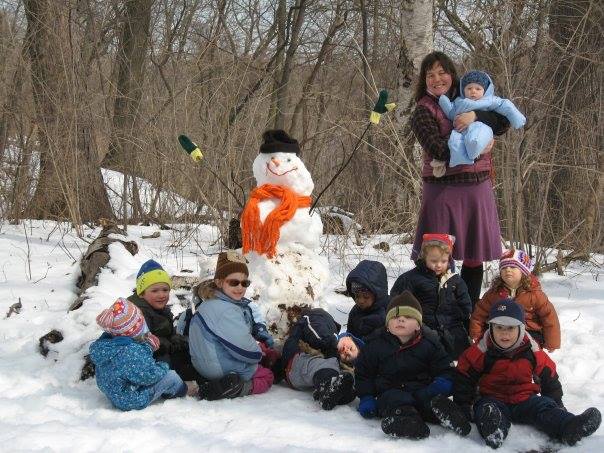
The Importance of Warmth
How to Dress Children for Cold Weather Success
By Miss
Belinda

This past
Friday, when playing outdoors at morning drop-off and after morning snack, we
found the temperature to be the coolest we’ve experienced for several
months. Plus, the coolness was exacerbated
by a breezy north wind. Many of the
children were woefully underdressed for the weather conditions. We were able to
scrounge up some extra outerwear and accommodate those, though not all, who
needed extra warmth, and it served as a good reminder that it was time to send
out our annual information and requests regarding dressing your child/children
for the cold months.
Because
we spend a lot of time outdoors in all seasons and in all types of weather, it
is imperative that the children be dressed appropriately. Now that we
have entered the cooler/cold months, just by observing the children’s behavior,
we can tell who is dressed warmly enough and who is not. Children who are
appropriately dressed are able to tolerate the cooler/cold weather for longer
periods of time. They are actively playing and enjoying themselves for the
entire time we’re outdoors (between 45-minutes and 1.5 hours depending on the
temperature including wind chill). Those who are not dressed warmly enough will
stop playing and go stand next to their caregiver and may begin to cry and/or
indicate that they are cold and want to go indoors. They are miserable and uncomfortable – and
that’s within the first 15-20 minutes.
A Child
Development Perspective:
The
importance of physical warmth cannot be overstated. From infancy until around
the ages of 9 – 12 yrs., children are learning what hot, warm, cool, cold feel
like within their bodies, meaning they have not yet developed awareness of
temperature regulation within their bodies. We cannot explicitly teach the
children to develop awareness of their body temperatures as this is a sense
that grows in consciousness over time from within the child. Thus, the adults have to be conscious of
warmth for them – until they’ve gained enough awareness to do this
for themselves. One of our tasks as parents and caregivers is to be a guardian
of your child’s warmth – to ensure the health-giving properties of warmth
for the young child.
*For
example; When a child is cold, they use their energy to keep their
temperature up potentially at the expense of growing. When a child is cold and wet, they are also
more susceptible to illness as there is less available energy to fight off
viruses. Speaking to the point of young
children having not yet developed awareness of temperature regulation within
their bodies - by the time they are able to indicate to us, either by behavior
and/or by verbalizing it, they have become too cold and will have a difficult
time warming up.
So – What
does it mean to be “A Guardian of Your Child’s Warmth?”
Dress
them in layers:
- 3 layers on top - Consisting of:
- A Base-Layer = The first
layer that lays next to the skin and helps the body retain heat/traps
the heat in – think long-johns
- A Mid-Layer = A
long-sleeved top
- An Outer-Layer = A sweater,
sweatshirt, fleece or fleece vest over the mid-layer
- 3-layers on the
bottom
– Consisting of:
- A Base-Layer = Leggings or
long-johns
- A Mid-Layer = Loose pants
i.e., sweat pants or something similar
- An Outer-Layer =
A
pair of warm, waterproof snowpants – or snowsuit
*Note:
Regarding Base-Layers – Material consisting of wool, wool/silk blend, or cotton
blends work very well to retain heat.
*Note: Regarding pants -
Elastic waist bands work best as they are easier for children to take on and
off themselves. Pants with
zippers/snaps/buttons are difficult for young children to manipulate which also
makes it challenging for those children who use the toilet.
*Preferably No Jeans – Jeans provide
very little, if any, warmth and generally come too tight and/or with
zippers/snaps/buttons, all of which can also make it difficult for those
children who use the toilet.
Outer
Layers Consisting of:
1.
A warm, waterproof jacket or snowsuit
2.
A pair of warm, waterproof snowpants or snowsuit
·
Re Jackets, Snowpants and Snowsuits: Please
make sure they are big enough to accommodate layering underneath – A good
rule of thumb is to size up one size – this will allow enough
room to accommodate extra layers as well as create an air pocket around the
body for warmth. If
jackets/coats/snowsuits fit too snugly, the body will get colder more quickly.
3.
Warm waterproof boots – A
good rule of thumb regarding boots is to get them one to 2 sizes bigger
than their shoe size…in order to accommodate thick socks (wool or similar)
and to create an air pocket around the foot for warmth. Just as in the case of snug fitting
jackets/snowsuits, if boots fit too snugly the foot will get colder more
quickly.
4.
Warm Mittens *(Gloves not
recommended for young children) – Hands stay warmer in mittens as the
fingers keep each other warm. Also –
young children can experience difficulty with trying to fit each individual
finger and thumb into their respective places on a glove.
- Mitten Suggestion: For infants
through young 3’s, try using a child-size pair of warm wool socks. I call them “sock mittens,” and they
work very well for the young child.
They allow for warmth as well as the flexibility children crave to
use their fingers and thumb when manipulating play items.
5.
Warm Hat that covers the ears – The
ears and head let out a considerable amount of heat, and cold winds can really
nip at children’s tender ears.
6.
Warm scarf/Neck gator – Wool
or wool-silk blend, if at all possible, but something to protect their tender
back and front of neck as well as chest area.
*Remember: If the child gets warm, we can always take
off layers. Better to be warm and adjust than to be cold and unprepared.
*Also - You
don’t have to spend a fortune on these items…some of the best winter gear
available can be found at thrift shops, ebay, etc.
*Our goal as
caregivers is to provide children with moments of self-awareness and language
with which to express their inner condition.
We can do this by:
Checking
in with them:
- Feel the back of
their neck
– Is it cold? Warm? Really warm? (this could indicate a fever)
In
summary:
With your
integral help in dressing your children in layers and providing both waterproof
and warm outer gear, we will be able to help the children regulate their
temperature both inside and outside.
*Please
keep providing a back-pack or canvas tote, etc. to bring the above outdoor
items from home to LifeWays and from LifeWays to home each day. It is invaluable for the children as well as
we caregivers when we have the proper clothing easily at hand for each child on
a daily basis.